content
over the last few years, the biggest issue i have run into when trying to make films is a lack of material to work with. there have been structural ideas i want to experiment with, but i haven’t had the images. a new camera got me back into the habit of shooting regularly, but lead to the production of Landscape #256 (2025) as a digital diary film, and even when i’ve tried to continue that practice, there is still the diary-ness of that footage which isn’t exactly what i am looking to work with.
in this same period, i have found a productive value in oscillating between working on film and working on music. it is not a hard divide between the two practices, but it comes in waves as i spend more time working and thinking about one than the other. as well as is a good way to not keep hitting your head against the wall in one form, i have also found that applying a lot of the ways i think about film to musical form has got me around the barrier of not having a formal music education or much interest in writing music chromatically.
this does happen some ways in reverse, but now i want to think more explicitly about using it to tackle this issue of content; how can i apply the sound generation techniques of electronic music to producing images for experimental filmmaking. to be even more specific, i want to think about two methods, synthesis and sampling.
sampling is the easier side to imagine, as there is a clear equivalent in filmmaking with found footage. we have a long history of work exploring this. i’m not pushing back against this, but i don’t think too much needs to be said about the basic idea. it all maps pretty cleanly in this analogy for now.
synthesis is a bit more complicated. there are various practices which could be categorised in this way, so lets think about some of them:
first of all we could say this is just shooting images - especially digital - but i think the musical equivalent there would be acoustic instruments. this then brings us to the obvious opposition, animation. there’s definitely a strong argument for this, and i’ve spent a lot of time thinking about animation and comics as forms where you can build something completely new out of nothing, but for now i want to leave them to the side as a parallel form. the frame by frame nature of animation includes the cut within itself, so it would be reductive to reduce this to just being source material in the way i am considering.
the other existing idea i want to get out of the way is videosynthesis. this is definitely an area where i’ve not got enough knowledge or experience, but i’m also quite sure it’s not what i’m looking for either. often linked to specific hardware, this field seems to replicate a lot of my issues with the boutique synth world. these machines have interesting ideas with a lot of thought and care gone into the design, but the final product is a way of recreating those prefixed algorithms. good work can be made with the tools, but my interest lies more in the design of them than actually using them.
what this leaves me with is ‘generators’. CGI is clearly part of this, but similar to animation, it’s a self contained field and above the level i am thinking about. a more rudimentary approach is the generators in an NLE. the screenshot below are those default generators in DaVinci Resolve.
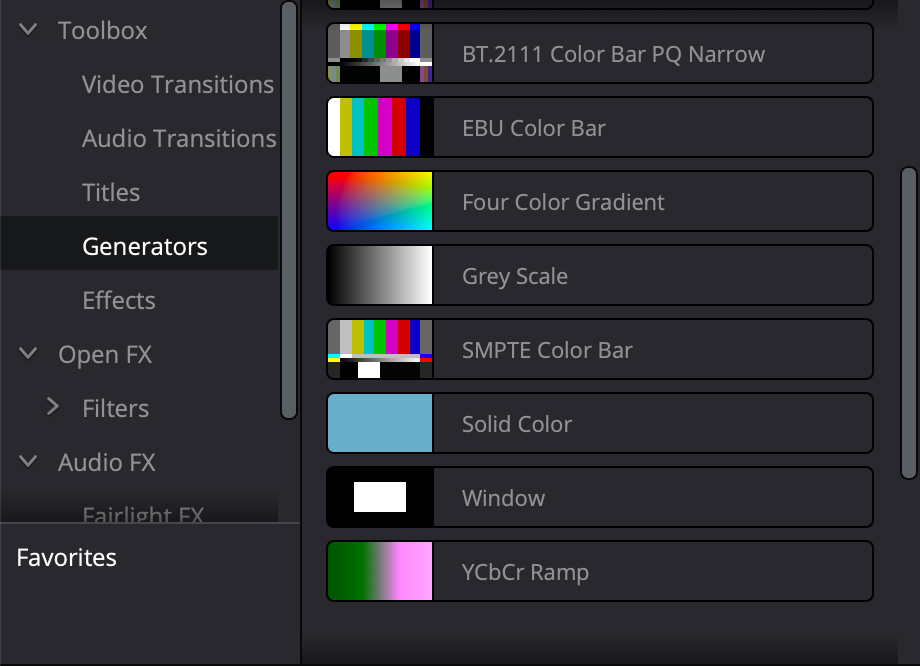
as someone interested in simple ideas of sonic synthesis, these feel like the equivalent building blocks to start with in video. i’ve been able to do a lot of work with a small amount of sine waves simply processed through pitch and time, i think this can be applied here too.
moving from theory to filmmaking, i want to consider this content within a larger electronic film project. integrating synthesis and sampling as part of a composition that positions these materials as material, with and against each other.